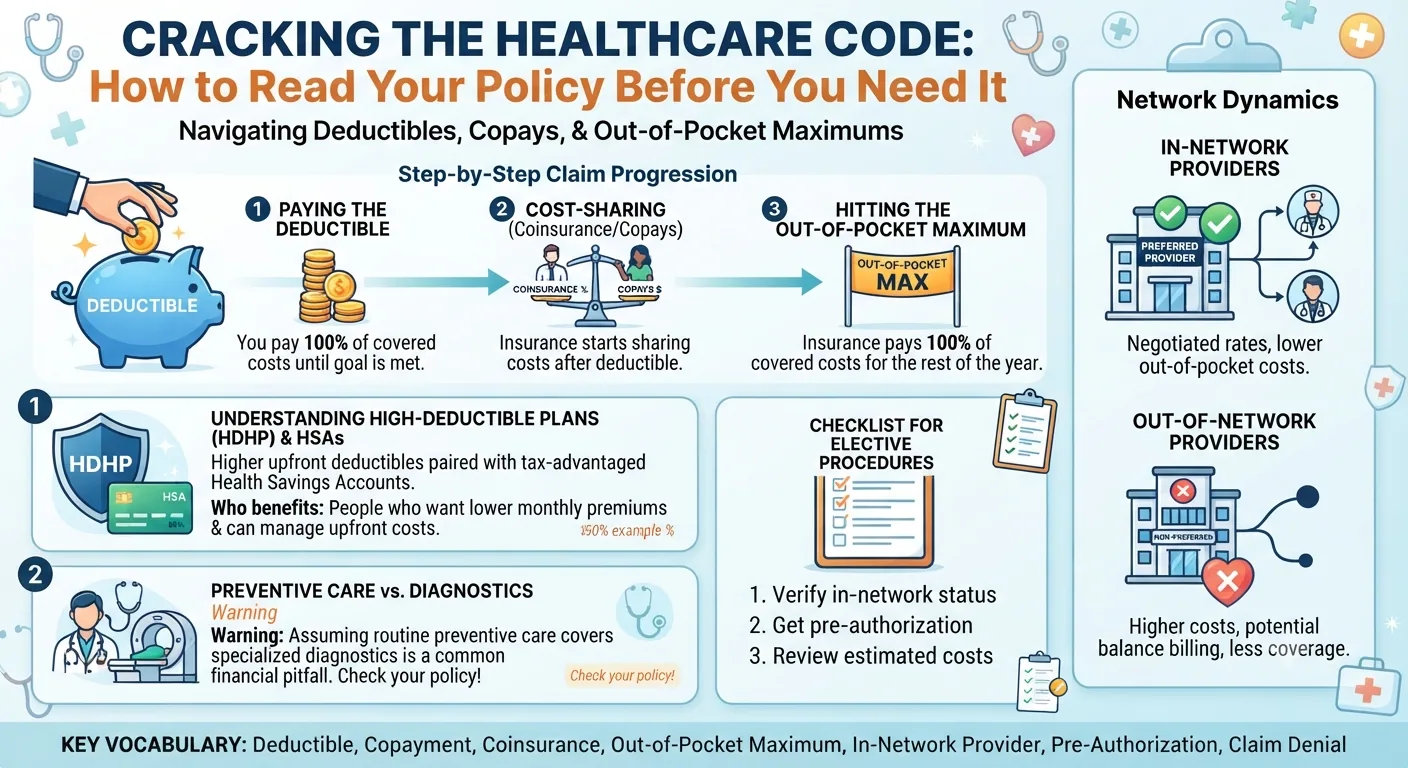
Cracking the Healthcare Code: How to Read Your Policy Before You Need It
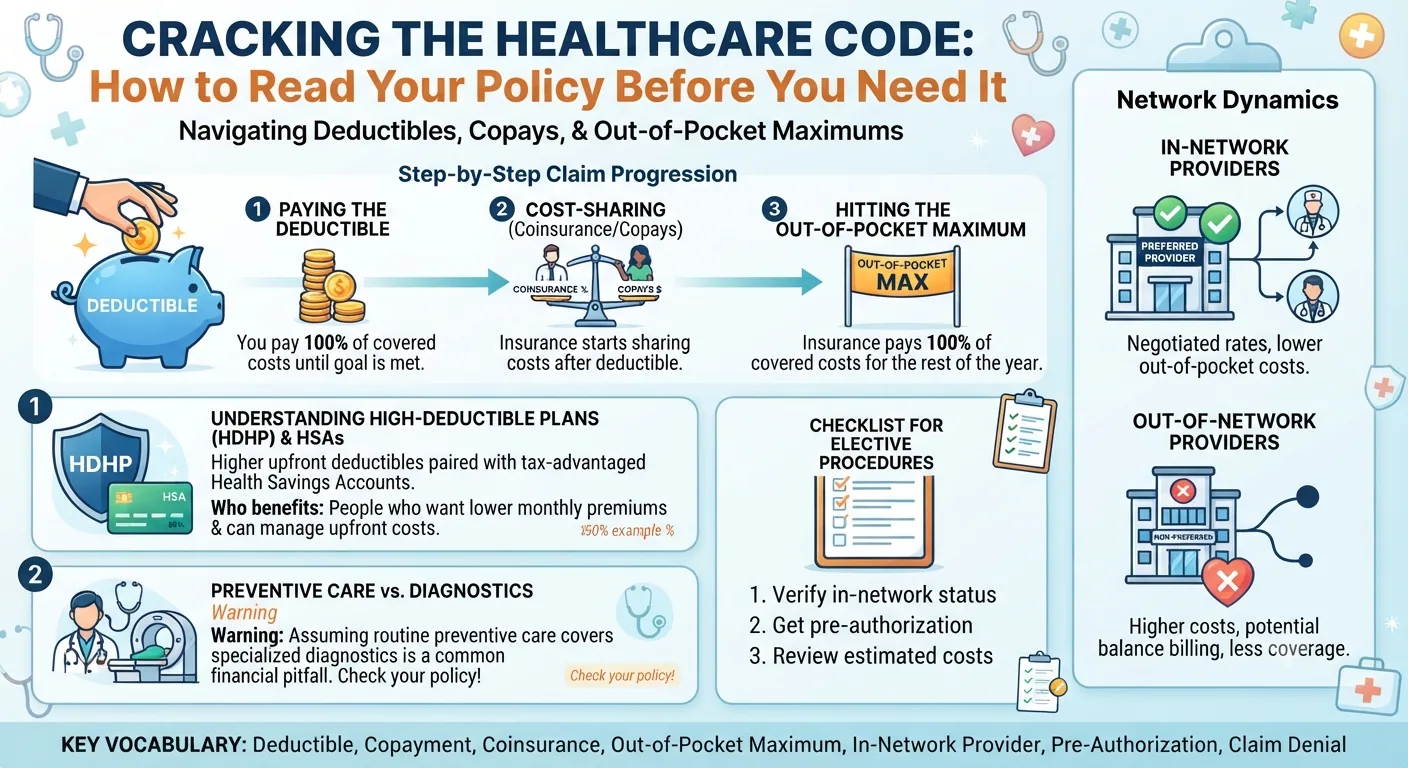
⚠️ Truyện hư cấu phục vụ giải trí. Nhân vật & tình tiết là sản phẩm tưởng tượng.
Navigating the world of healthcare insurance can often feel like trying to decipher an ancient secret language written by people who really do not want you to understand it. Most of us do not think about our health insurance policies until we are sitting in a doctor's office feeling sick, or worse, staring at a confusing medical bill that arrived in the mail weeks after a routine checkup. The jargon can be overwhelming. Terms like deductibles, copays, coinsurance, and out-of-pocket maximums are tossed around casually by insurance representatives as if everyone went to medical billing school. When you do not know what these terms mean, it is very easy to make costly mistakes, skip necessary care out of fear of the unknown, or get hit with surprise medical bills that can completely derail your household budget. But taking control of your healthcare planning does not require a degree in finance or medicine. It simply requires breaking down the core concepts into clear, manageable pieces so you can read your policy before you actually need to use it.
To make sense of how health insurance works, it helps to start with the foundational building blocks of any policy. Think of your health insurance plan as a financial risk-sharing agreement between you and the insurance company. You pay a monthly fee, known as a premium, just to keep the insurance active, whether you go to the doctor or not. However, paying that monthly premium does not mean that every single doctor visit, prescription, or hospital stay is completely free. In fact, most plans require you to pay out of your own pocket for medical services up to a certain point before the insurance company really starts chipping in heavily. This is where the concept of the deductible comes into play.
Your deductible is the specific dollar amount you must pay out of your own pocket for covered medical care before your insurance plan starts paying its share. For example, if your plan has a two thousand dollar deductible, you are responsible for paying the first two thousand dollars of your medical bills for that year. Once you cross that two thousand dollar threshold, you have met your deductible for the year. It is crucial to understand that your monthly premium does not count toward your deductible. Your premium is just the ticket to enter the game, while your deductible is the toll you have to pay on the road before the insurance benefits actually kick in. Many people make the mistake of assuming that because they pay a hefty premium every month, their very first doctor visit of the year will only cost a small copay. Depending on the plan design, if you have not met your deductible yet, you might be paying the full negotiated rate for that visit out of your own pocket.
Once you finally meet your deductible, you enter a new phase of cost-sharing, where you and the insurance company share the financial burden of your medical expenses. This is usually handled through copayments or coinsurance. A copayment, or copay, is a fixed dollar amount that you pay for a specific service or prescription. For instance, your plan might require a twenty dollar copay for a primary care doctor visit or a ten dollar copay for a generic prescription. Copays are usually straightforward because you know the exact amount before you walk into the pharmacy or clinic, and in many plans, copays do not even require you to meet your deductible first, though they will still count toward your overall yearly limits.
Coinsurance, on the other hand, is a percentage of the total medical bill that you are required to pay after your deductible has been met. If your plan has a twenty percent coinsurance rate for a specialized procedure, and the total cost of that procedure is one thousand dollars, you will pay two hundred dollars, while the insurance company pays the remaining eight hundred dollars. Coinsurance can sometimes catch people off guard because the exact dollar amount fluctuates depending on the total cost of the care provided. If a medical test costs five thousand dollars, twenty percent suddenly becomes one thousand dollars out of your pocket.
Fortunately, there is a financial safety net designed to protect you from catastrophic medical debt, and it is called the out-of-pocket maximum. The out-of-pocket maximum is the absolute highest amount you will have to pay for covered services in a single plan year. Once you reach this financial ceiling through your deductible payments, copays, and coinsurance, the insurance company is legally required to pay one hundred percent of all covered medical expenses for the rest of that year. Understanding your out-of-pocket maximum is arguably one of the most important aspects of healthcare planning. If you are facing a major surgery, chronic illness management, or an unexpected medical emergency, knowing this number tells you the maximum financial risk you face during that year. It transforms a terrifying, unpredictable future into a known financial boundary, giving you peace of mind when health issues arise.
However, health insurance companies do not just pay any doctor or hospital you decide to visit. They build specific networks of healthcare providers, hospitals, and facilities that have agreed to accept discounted rates for their services. This brings us to the crucial distinction between in-network and out-of-network providers. An in-network provider is a doctor, clinic, or hospital that has a direct contract with your insurance company. Because of this contract, they agree to provide services at a pre-negotiated, lower rate, and your insurance company agrees to cover a larger portion of the bill. When you stay in-network, your costs are predictable, your deductible applies normally, and your insurance benefits function as intended.
On the flip side, an out-of-network provider has no contract with your insurance company. They can charge whatever rates they see fit, and your insurance company is under no obligation to help pay for those services. If you choose to see an out-of-network doctor, you might find that your insurance refuses to cover the bill entirely, or that you are subjected to a completely separate, much higher out-of-network deductible and coinsurance rate. Even worse is the phenomenon known as balance billing. This happens when an out-of-network doctor bills you for the difference between what they charge and what your insurance company is willing to pay. Imagine receiving a medical procedure that costs ten thousand dollars, your insurance policy decides it is only worth three thousand dollars, and the out-of-network doctor sends you a bill for the remaining seven thousand dollars. Navigating network dynamics carefully is one of the single most effective ways to prevent emergency room bill shock and financial disaster.
Emergency situations, of course, add another layer of complexity. When you are having a severe medical emergency, you cannot realistically pause to check whether the nearest emergency room is in-network or out-of-network. Fortunately, federal consumer protections and modern regulations have largely solved emergency room surprise billing by requiring insurance companies to cover emergency services at in-network rates, regardless of whether the specific hospital or treating physician was technically out-of-network. Even so, once you are stabilized and moved to a regular room for ongoing recovery, the rules can change rapidly. Being transferred to an out-of-network rehabilitation facility or being treated by an out-of-network consulting specialist while in the hospital can still trigger unexpected costs. Always ask questions, advocate for yourself, and request in-network providers whenever possible during your hospital stay.
Another area where patients frequently run into financial surprises involves preventive care versus specialized diagnostics. Under many modern health plans, routine preventive services such as annual physical exams, standard vaccinations, and certain cancer screenings are covered at one hundred percent by the insurance company, meaning you pay nothing out of pocket even if you have not met your deductible yet. This is a fantastic public health initiative designed to catch illnesses early before they become expensive to treat. However, a dangerous financial trap opens up when a routine preventive visit crosses over into a diagnostic conversation. If you go to your doctor for a free annual wellness exam, and halfway through the appointment you mention a lingering stomachache or a new joint pain, the doctor may transition from a preventive checkup to a diagnostic evaluation. When that happens, the billing code changes, and your routine free visit suddenly becomes a paid office visit that applies to your deductible or requires a copay. Furthermore, if your doctor orders specialized blood work, an ultrasound, or an MRI during that visit, those diagnostic tests are rarely covered under the free preventive umbrella. Always clarify with your provider whether a specific test or conversation is considered strictly preventive or diagnostic before proceeding, so you are not caught off guard by a bill for services you assumed were free.
As you look at different insurance plans on the market, you will frequently encounter High-Deductible Health Plans, often paired with Health Savings Accounts, commonly known as HDHPs and HSAs. An HDHP is a health insurance plan with a higher deductible than a traditional insurance plan, paired with a lower monthly premium. Because you are taking on more of the upfront financial risk by agreeing to pay a larger deductible before insurance kicks in, the insurance company rewards you with a much lower monthly payment. These plans have gained massive popularity, but who actually benefits from them the most?
High-Deductible Health Plans combined with Health Savings Accounts are typically ideal for individuals who are generally healthy, do not anticipate needing regular medical care or prescription drugs throughout the year, and want the protection of catastrophic health insurance without paying high monthly premiums. The true power of an HDHP lies in the Health Savings Account, which is a special type of personal savings account that can only be used for medical expenses. HSAs offer a unique triple tax advantage that is unmatched by any other financial vehicle. First, the money you contribute to an HSA is completely tax-deductible, lowering your taxable income for the year. Second, any interest or investment growth inside the HSA is entirely tax-free. Third, withdrawals from the HSA are completely tax-free as long as they are used to pay for qualified medical expenses, such as doctor visits, prescriptions, dental care, and vision needs.
For someone who is healthy and can afford to contribute money into an HSA, the strategy is compelling. You save the money you would have spent on high monthly premiums, put it into a tax-advantaged HSA, let it grow over time, and use it to pay for healthcare expenses as they arise. Moreover, unlike flexible spending accounts, money in an HSA never expires or rolls over at the end of the year; it stays with you forever, even if you change jobs or switch insurance plans. However, HDHPs can be financially punishing for individuals with chronic health conditions, frequent prescription needs, or regular doctor visits. If you know you will max out your medical utilization every single year, paying a lower monthly premium on an HDHP often results in spending more total money out of pocket because you have to clear that massive deductible before any real insurance assistance begins. Evaluating your personal health history and expected medical needs for the coming year is the only way to determine whether an HDHP makes sense for your budget.
When you do need specialized procedures, surgeries, or expensive treatments, another critical insurance mechanism comes into play: pre-authorization, also known as