Cracking the Healthcare Code: How to Read Your Policy Before You Need It
⚠️ Truyện hư cấu phục vụ giải trí. Nhân vật & tình tiết là sản phẩm tưởng tượng.
Navigating the world of health insurance can often feel like trying to decipher an ancient language written by someone who specifically wanted to confuse you. Every year, millions of people open their employer benefit packets or healthcare exchange portals, stare at a wall of intimidating terms like deductibles, coinsurance, and out of pocket maximums, and simply pick the cheapest monthly premium or stick with whatever they had last year. Then, an unexpected medical issue happens, a bill arrives in the mail, and sudden confusion turns into sheer panic. It does not have to be this way. Understanding how your health insurance actually works is one of the most empowering financial skills you can develop for yourself and your family. When you take the time to decode your policy before you need it, you transform from a passive victim of surprise medical billing into an informed consumer who can advocate for their own wallet and well-being. Let us break down the core components of health insurance, walk through how a medical claim travels through the system, examine the mechanics of high deductible health plans, and look at practical steps you can take to protect yourself from financial shocks.
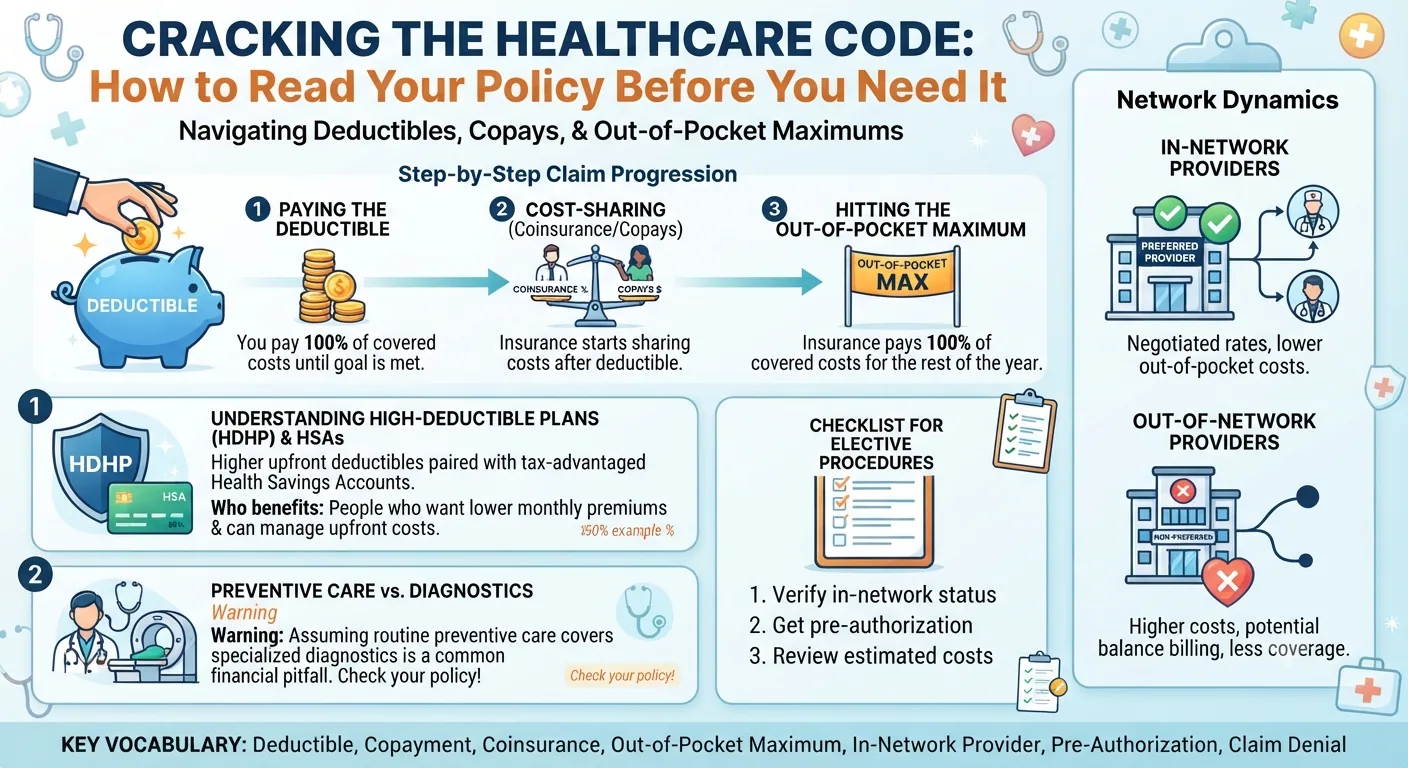
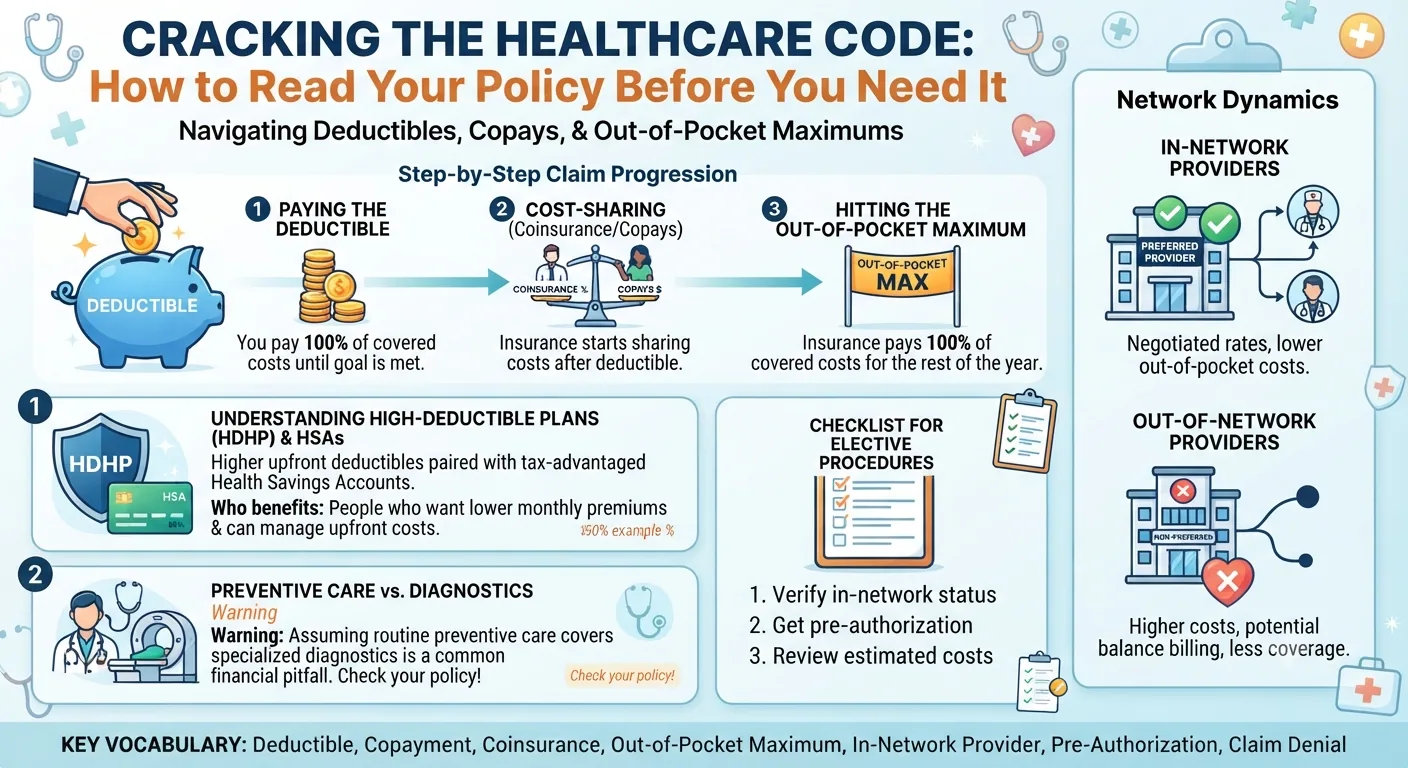
To understand health insurance, we first need to master the fundamental vocabulary. Think of these terms as the basic building blocks of your policy. If you do not know what these words mean, you are essentially driving blindfolded on a financial highway. The first term you will always encounter is your monthly premium. This is the fixed amount you pay to your insurance company every single month, whether you go to the doctor zero times or twenty times. Just like paying for a subscription streaming service or your car insurance, the premium keeps your policy active and ready to use. Many people make the mistake of thinking that because they pay a high monthly premium, their healthcare is completely covered from the moment they step into a clinic. That is rarely how it works. In fact, most traditional plans require you to pay for a significant portion of your medical care out of your own pocket before the insurance company starts chipping in their share.
That brings us to the second and perhaps most misunderstood term, the deductible. Your deductible is the amount of money you must pay out of pocket for your medical care before your insurance plan begins to pay anything. Let us say your deductible is two thousand dollars. If you visit the doctor in January and the bill for the visit is one hundred and fifty dollars, you are responsible for paying that entire one hundred and fifty dollars out of your own pocket. The insurance company does not pay a dime toward that visit. Your payment goes toward chipping away at your two thousand dollar deductible. You repeat this process every time you get care until your cumulative payments reach that two thousand dollar threshold. Once you hit that magic number, you have met your deductible for the year, and the insurance company finally steps in to share the financial burden. Keep in mind that your monthly premiums do not count toward your deductible. Only the money you spend on actual medical services and treatments goes toward meeting that amount. Furthermore, most health insurance plans reset their deductibles every single calendar year, usually on January first, which means you start back at zero every twelve months whether you like it or not.
Once you have met your deductible, you enter the cost-sharing phase of your healthcare journey. During this phase, you and your insurance company split the cost of your medical care. This cost-sharing usually takes one of two forms, known as copayments and coinsurance. A copayment, or copf for short, is a flat, fixed fee you pay every time you receive a specific medical service. For example, your plan might require a twenty dollar copay for a primary care doctor visit, a fifty dollar copay for a specialist visit, and a fifteen dollar copay for a generic prescription. You pay this flat fee directly to the provider at the time of your visit, regardless of what the total bill actually is. Coinsurance, on the other hand, is a percentage of the total medical bill that you are responsible for paying after you have met your deductible. For instance, if your plan has a twenty percent coinsurance rate, and you undergo a medical procedure that costs one thousand dollars, you will have to pay two hundred dollars, while your insurance company pays the remaining eight hundred dollars. Copays and coinsurance are two entirely different mechanisms, though many people use the words interchangeably, which leads to great confusion when reviewing medical bills.
Even with cost sharing, healthcare costs can spiral out of control if you face a major medical event, such as surgery, a prolonged hospital stay, or treatment for a chronic illness. To protect you from financial ruin, every health insurance policy includes a crucial safety net known as the out of pocket maximum. The out of pocket maximum is the absolute most money you will be required to spend on covered medical services in a single plan year. Once the total amount you have paid toward your deductible, copayments, and coinsurance reaches this maximum limit, your insurance company is legally obligated to pay one hundred percent of all allowed medical costs for the rest of the year. This is the ceiling of your financial liability. While hitting your out of pocket maximum usually means you have experienced a very expensive health year, it provides immense peace of mind knowing that your medical bills cannot go beyond that predetermined limit. It is important to note that your monthly premiums never count toward your out of pocket maximum. Only your direct medical expenses count toward this cap, and once again, this limit resets every January first.
Now that we know the vocabulary, let us trace how a typical medical claim moves through the system from the moment you make an appointment to the day the final bill is settled. Understanding this lifecycle helps demystify those confusing statements of benefits that arrive in your mailbox weeks after a doctor visit. Imagine you wake up with a persistent cough and decide to see a doctor. You call a local clinic, make sure they accept your insurance, and schedule an appointment. When you arrive at the clinic, the receptionist asks for your insurance card and collects your copayment, which might be thirty dollars. You see the doctor, receive a diagnosis, and get a prescription. A few days later, the doctor office submits a medical claim to your insurance company. This claim is a detailed electronic document outlining the services provided, the diagnostic codes used, and the charges associated with your visit.
When the insurance company receives this claim, their processing department goes to work. They compare the charges submitted by the doctor against your specific insurance contract and the negotiated rates they have agreed upon with that provider. Let us say the doctor billed three hundred dollars for the visit, but because your insurance company has a pre-negotiated network contract, the allowed amount for that visit is only two hundred dollars. The remaining one hundred dollars is written off as a contractual discount, meaning you do not have to pay it and the doctor cannot bill you for it. Next, the insurance company looks at your account to see where you stand with your deductible. If you have not met your deductible yet, the insurance company applies that two hundred dollar allowed amount directly to your deductible balance. Because you still owe your deductible, the insurance company pays zero dollars to the doctor, and they generate a document called an Explanation of Benefits, or EOB, which they send to you.
It is vital to understand that an Explanation of Benefits is not a bill. Many people receive an EOB in the mail, panic because they see a large balance, and pay it directly to the insurance company or doctor before they even know what is going on. The EOB is simply a summary statement that explains how the insurance company processed the claim. It shows the amount billed by the doctor, the discount applied, how much went toward your deductible, and how much you ultimately owe the provider. A few days after you receive the EOB, the doctor office will send you an actual invoice for the exact amount indicated on the EOB. You then pay that amount directly to the doctor office, and the claim is officially closed. If you have already met your deductible for the year, the process looks a bit different. Instead of applying the allowed amount to your deductible, the insurance company will calculate your coinsurance percentage, pay their share to the doctor, and leave you responsible for your specific coinsurance portion, which you will then see on your bill.
As you navigate your healthcare choices, you will inevitably encounter the distinction between in-network and out-of-network providers. This distinction can literally mean the difference between a manageable medical bill and financial devastation. An in-network provider is a doctor, hospital, clinic, or specialist who has signed a contractual agreement with your insurance company. These providers have agreed to accept a pre-negotiated, discounted rate for their services in exchange for being included in your insurance plan directory, which brings them a steady stream of patients. Because of these negotiated rates, seeing an in-network provider is always much cheaper for you. Your insurance company covers a larger portion of the cost, and you benefit from lower overall prices.
An out-of-network provider, on the other hand, has no contract with your insurance company. They can charge whatever rates they see fit, and your insurance company has no obligation to help pay for their services. If you visit an out-of-network doctor, your insurance plan might refuse to cover the visit entirely, or they might cover a very small fraction of it while requiring you to pay a much higher coinsurance rate. Even worse, out-of-network providers can engage in a practice known as balance billing. Balance billing occurs when a doctor bills you for the exact difference between what they charge and what your insurance company is willing to pay. If an out-of-network surgeon charges ten thousand dollars for a procedure, and your insurance company decides that the reasonable rate is only three thousand dollars, the surgeon can legally send you a bill for the remaining seven thousand dollars. This is what we call bill shock, and it catches thousands of unsuspecting patients off guard every single year.
To prevent emergency room bill shock and unexpected out-of-network charges, you must become proactive. If you need an elective procedure, a diagnostic test, or a specialist consultation, do not simply trust that the facility or doctor is in-network because they are located inside a hospital that takes your insurance. Hospitals often lease space to independent doctors and groups who may belong to an entirely different insurance network. Before scheduling any procedure, take the time to run through a verification checklist. First, call your insurance company directly and ask them to verify in writing whether the specific physician and the specific facility are in your network. Second, ask for the specific billing codes, known as CPT codes, that the doctor plans to use for your procedure. Third, call your insurance company back with those specific codes to confirm coverage details and find out if you need pre-authorization. Pre-authorization, sometimes called prior authorization, is a requirement where your doctor must get approval from your insurance company before performing a service, otherwise the insurance company can legally deny the claim entirely, leaving you holding the entire bill.
Another major trend in healthcare planning is the rise of High Deductible Health Plans, commonly