Weaponized Finance: Can the U.S. Dollar Maintain Hegemony Against a Fragmenting World?
⚠️ Truyện hư cấu phục vụ giải trí. Nhân vật & tình tiết là sản phẩm tưởng tượng.
When global financial history is written, the architectural masterpiece of the post-war era will not be a bridge or a skyscraper, but the quiet, pervasive plumbing of the global monetary system. At the very center of this architecture sits the United States Dollar Index, tracking the greenback against a basket of developed-market peers, serving as the ultimate thermometer of global liquidity, risk appetite, and geopolitical leverage. For decades, the supremacy of the dollar has been treated as an immutable law of economic gravity. Yet beneath the calm surface of daily foreign exchange markets, tectonic pressures are building. A coalition of rising economic powers, spearheaded by BRICS plus nations, is systematically exploring and expanding alternatives to dollar dominance, driven by a mixture of strategic ambition and defensive paranoia. To understand whether King Dollar can maintain its throne against a fragmenting world, we must examine the intersection of geopolitics, structural economics, and the stubborn realities of international trade plumbing.
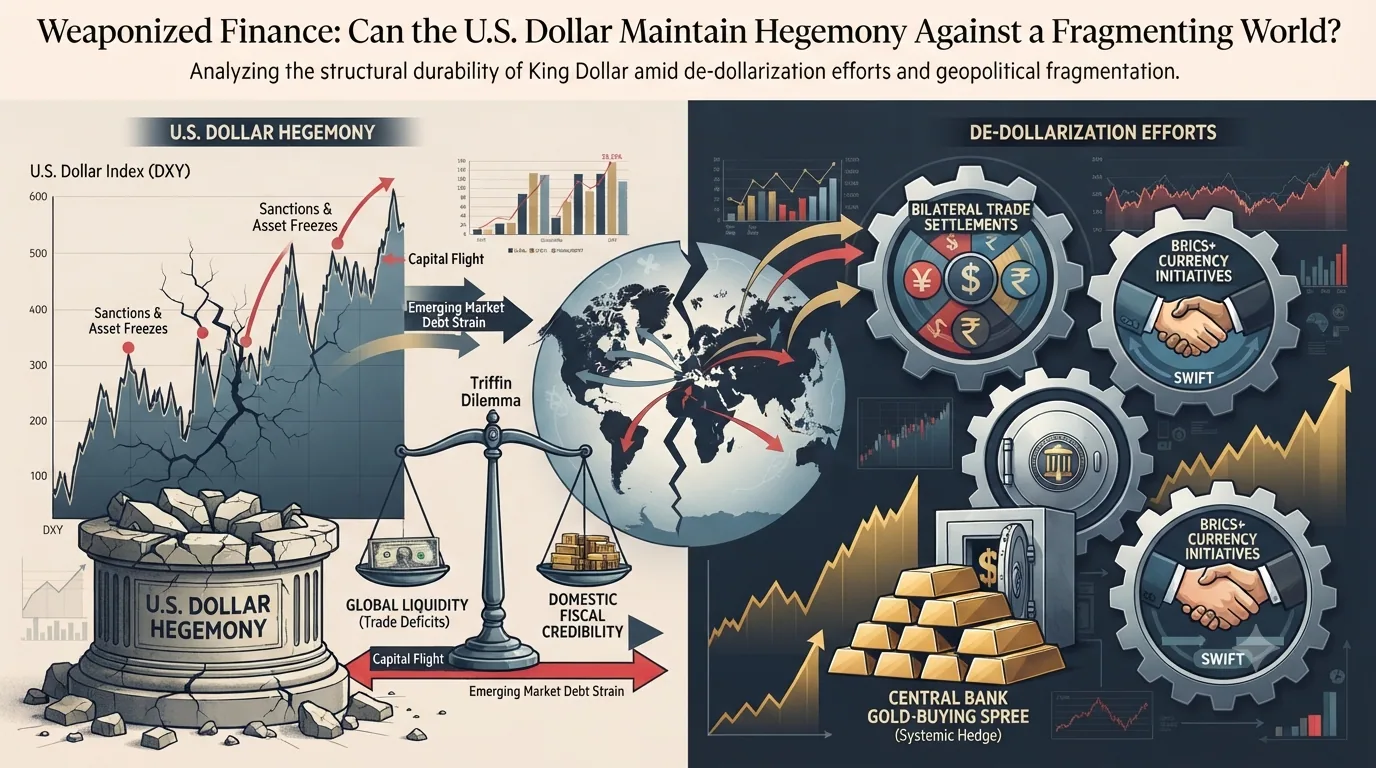
The modern narrative of de-dollarization is frequently misunderstood by both its most zealous proponents and its most dismissive critics. It is rarely a sudden, dramatic collapse where global markets wake up one morning and abandon the greenback overnight. Instead, it manifests as a slow, deliberate diversification of foreign exchange reserves, an experimental rise in bilateral trade settlements using local currencies, and a structural migration toward hard assets that sit entirely outside Western financial jurisdiction. The primary catalyst for this shift did not originate in an economics textbook, but in the conference rooms where financial sanctions are drafted and enforced. When sovereign central bank reserves can be frozen with the stroke of a pen, as occurred during the unprecedented sanctioning of major central bank assets following geopolitical flashpoints, the risk profile of holding U.S. Treasuries fundamentally changes. For decades, dollar assets were viewed by risk-managing central bankers as the ultimate risk-free asset. Today, they carry availability risk, turning a yield-bearing instrument into a potential geopolitical hostage.
This weaponization of finance has triggered a profound behavioral shift among central banks across the Global South and emerging markets. Rather than keeping their surpluses neatly sequestered in New York or London, monetary authorities have embarked on multi-year structural buying sprees of physical gold. Gold acts as the ultimate neutral reserve asset because it is nobody else's liability. It cannot be disconnected from a messaging network, it cannot be frozen by an executive order, and it carries no counterparty default risk. The sheer volume of official gold purchases by central banks in recent years underscores a quiet vote of no confidence in the unmitigated safety of the Western financial grid. While the U.S. Dollar Index (DXY) continues to fluctuate based on interest rate differentials and relative economic growth between the United States and its G10 peers, the underlying plumbing is experiencing microscopic fractures. Central banks are choosing to hold a smaller percentage of their total reserves in greenbacks, not necessarily because they want to trade exclusively in an alternative paper currency, but because they want optionality in a fracturing multipolar world.
Yet, talking about de-dollarization is far easier than executing it, because the alternative payment systems face steep liquidity and trust hurdles that cannot be wished away by political declarations. The dominance of the dollar rests upon a foundation of deep, highly liquid, and open capital markets. When an emerging market exporter sells goods, they do not just want a currency that can buy goods from one specific bilateral partner; they want a medium of exchange that is universally accepted, deeply backed by trustworthy legal institutions, and capable of absorbing massive capital flows without distorting domestic prices. The SWIFT messaging network and the dollar-clearing apparatus managed through New York correspondent banks are extraordinarily sticky precisely because they offer unmatched network effects. If two countries decide to bypass the dollar and settle trade in their own local currencies, they immediately run into the surplus-deficit imbalance problem. If Country A exports oil to Country B, and Country B pays in its own domestic currency, what does Country A do with a massive pile of that currency if it does not want to buy an equivalent amount of goods back from Country B? Without deep, open capital markets where those local currencies can be freely and safely invested in risk-free sovereign debt, bilateral arrangements quickly stall out into clunky, bilateral barter systems.
This brings us directly to the structural contradiction at the heart of American hegemony: the modern incarnation of the Triffin Dilemma. First articulated by Belgian-American economist Robert Triffin during the Bretton Woods era, this dilemma posits an irreconcilable conflict for any nation whose currency serves as the world's primary reserve asset. To supply the rest of the world with the liquidity necessary to grease the wheels of global trade and maintain reserve balances, the issuing nation must run persistent balance-of-payments current account deficits. It must import more than it exports, allowing its currency to continuously flow abroad. For the United States, this has historically translated into the so-called exorbitant privilege, allowing Americans to borrow cheaply, maintain a higher consumption standard, and finance domestic deficits with foreign savings. However, the long-term cost of this privilege is the steady hollowing out of domestic manufacturing, mounting twin deficits, and an increasingly fragile fiscal architecture.
In the modern era, the Triffin Dilemma has evolved into a high-stakes fiscal tightrope walk. As global demand for dollar liquidity remains structurally high, the United States is compelled to issue vast quantities of sovereign debt. But as the national debt scales to unprecedented heights against a backdrop of domestic political polarization, foreign reserve managers and private investors are forced to ask difficult questions about long-term fiscal credibility and inflation risk. If the United States tightens fiscal policy and imposes aggressive trade protections to rebuild its domestic industrial base, it starves the global system of the dollar liquidity it has relied upon for generations. Conversely, if it continues running massive fiscal and trade deficits to keep the world awash in dollars, it risks eroding the very confidence and purchasing power that underpins the currency's premier status. This trade-off creates a persistent vulnerability, acting as an internal stressor that complements the external pressures applied by foreign rivals.
Furthermore, the structural strength of the dollar imposes a punishing economic toll on emerging market economies that carry heavy dollar-denominated debt burdens. When the Federal Reserve hikes interest rates to combat domestic inflation, the DXY surges, drawing capital back toward U.S. shores as global investors chase higher yields. For developing nations with corporate and sovereign debt denominated in greenbacks, this dynamic triggers severe capital flight. Their local currencies depreciate, the cost of servicing foreign debt skyrockets, and domestic central banks are forced into a painful choice between raising interest rates to defend their currencies or letting inflation run rampant. This systemic strain creates a powerful economic incentive for non-Western nations to seek alternative invoicing mechanisms, regional swap lines, and de-dollarized corridors. Even if these alternative networks are less efficient and more costly in the short term, they are increasingly viewed by policymakers in the Global South as an essential insurance policy against the centrifugal forces of U.S. monetary policy.
As we analyze the current landscape, it becomes clear that the fate of the U.S. dollar will not be decided by a dramatic single event, but by a gradual erosion of margins. The dollar is not about to lose its crown tomorrow; the infrastructure of global finance is simply too entrenched, and the alternatives are too politically fragmented and economically constrained to mount a unified replacement. The Eurozone lacks a single, unified debt instrument on the scale of U.S. Treasuries; the Chinese renminbi remains limited by strict capital controls and a lack of full convertibility; and a hypothetical common BRICS currency remains an aspirational talking point constrained by profound geopolitical distrust among its own members. Yet, the marginal share of the dollar in global reserves is slowly drifting downward, replaced not by another sovereign paper currency, but by gold, localized bilateral pacts, and a growing fragmentation of trade corridors. King Dollar remains the undisputed heavyweight of the global monetary arena, but the kingdom is no longer unified, and the margins are being steadily contested by a world that has learned the hard lessons of financial vulnerability.
Bài viết liên quan

Beyond the Hype: Wall Street Demands Return on Investment from the Trillion-Dollar AI Capex Supercycle
The Yield Reality: How Stubborn Treasury Yields Are Forcing Wall Street to Rethink Risk

Harvest of Glass: The Bitter Civil War Splitting Midwestern Farming Towns Over Solar Leases