The Golden Handcuffs: Why America’s 3% Mortgages Have Frozen the Housing Market in Place
⚠️ Truyện hư cấu phục vụ giải trí. Nhân vật & tình tiết là sản phẩm tưởng tượng.
For years, the American housing market operated on a predictable and rhythmic cycle. Families grew, jobs shifted across state lines, children graduated, and people moved. Homeowners traded up for larger yards, downsized into quiet suburban bungalows, or relocated across the country in search of better weather and thriving local economies. It was a fluid ecosystem of mobility, where turning the key on a new front door was as American as apple pie and credit cards. Today, that engine has ground to a near-total halt, locked in place by a financial phenomenon unlike anything the modern economy has ever witnessed. It is a story of golden handcuffs, unprecedented monetary policy collisions, and a generational divide that is reshaping the American dream of homeownership.
To understand why the housing market is currently frozen, we have to look back at the unique macroeconomic conditions of the early pandemic era. When global uncertainty struck in twenty twenty, the Federal Reserve slashed benchmark interest rates to near zero in an effort to stabilize the financial system. Mortgage rates followed suit, tumbling into a historic basement where thirty-year fixed loans could be secured anywhere between two point five and three point five percent. Millions of American homeowners seized the opportunity. Some refinanced existing debt to slash monthly payments by hundreds or even thousands of dollars. Others locked in those generational lows when buying their first or forever homes. For roughly sixty-two million American households holding a mortgage, those rates became a prized financial asset, a cheap liability wrapped in brick and mortar.
Then came the inflationary shockwaves of twenty twenty-two. To cool an overheating economy, the Federal Reserve executed one of the fastest tightening cycles in history, pushing benchmark interest rates up at a breakneck pace. Mortgage rates responded in kind, surging past six and eventually hovering persistently in the six to seven percent range. In textbook economic theory, a rapid doubling of borrowing costs should have triggered a massive wave of distress, forcing home prices to plummet as buyers retreated. Yet, that crash never happened. Instead, home prices remained stubbornly sticky, defying gravity even as the cost of debt doubled overnight.
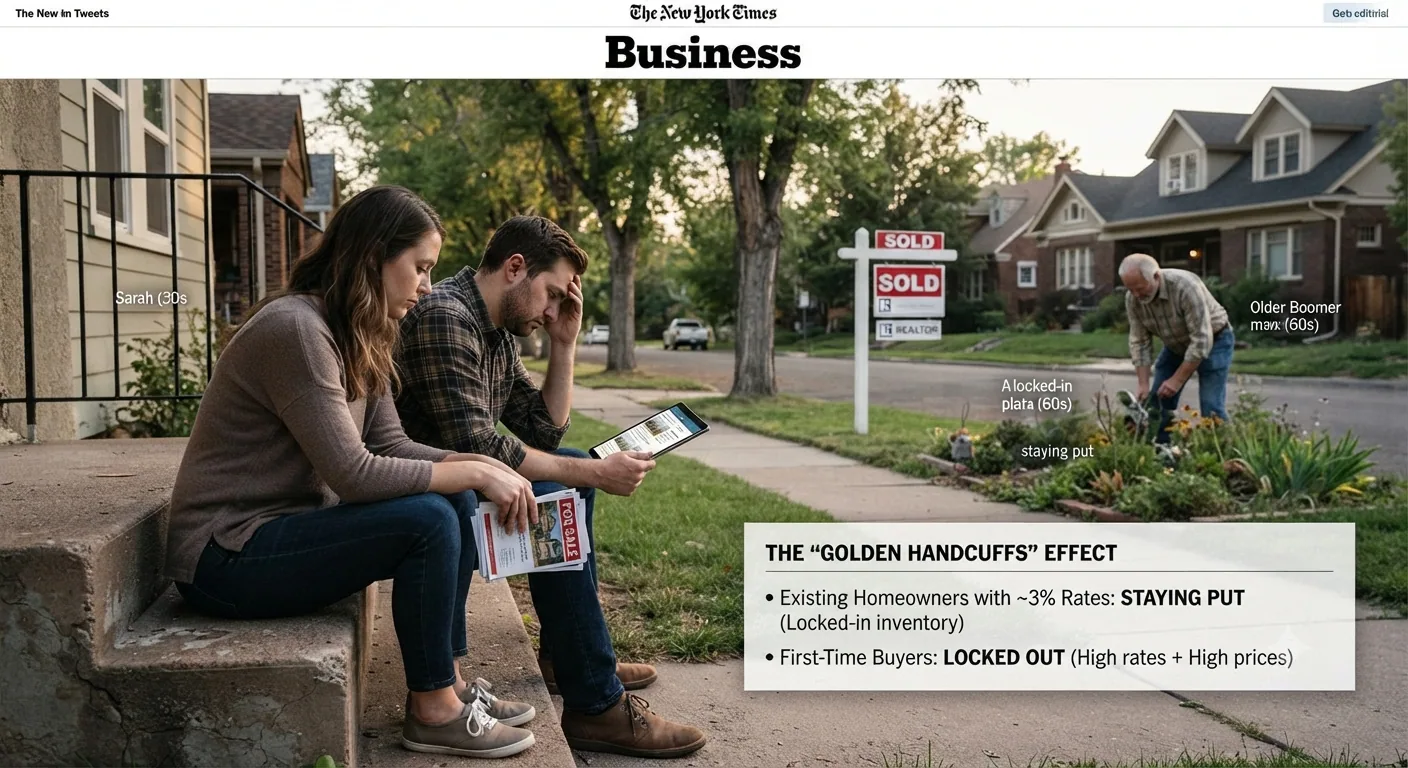
The primary culprit behind this defiance is the mortgage rate lock-in effect. Consider the math facing an average homeowner who secured a three percent mortgage on a four hundred thousand dollar loan back in twenty twenty. Their monthly principal and interest payment sits comfortably around sixteen hundred dollars. If that same homeowner decides to sell today and buy a comparable home at current market interest rates closer to seven percent, their monthly payment on the exact same loan amount balloons to over twenty-six hundred dollars. That is an extra ten thousand dollars a year vanishing into interest payments alone, for no additional square footage, no better neighborhood, and no upgraded kitchen. Millions of homeowners did the math, looked at their golden handcuffs, and decided they were staying put.
This mass refusal to move created a severe structural inventory paralysis across the nation. Existing home sales plummeted to multi-decade lows as normal life events—job relocations, growing families, divorces, and retirements—clashed with the insurmountable penalty of higher borrowing costs. Homeowners simply chose to remodel rather than relocate. They built backyard additions, finished basements, and updated kitchens, turning their existing houses into permanent compounds. While this was a rational individual choice for millions of families, collectively it starved the market of the resale inventory that first-time buyers and trade-up purchasers desperately rely on.
For first-time homebuyers, particularly millennials and Generation Z, the lock-in effect has created a brutal affordability squeeze. They entered their peak family-forming years right as inventory dried up and borrowing costs doubled. Trapped between elevated purchase prices driven by scarce supply and punishing mortgage rates that severely restrict their debt-to-income ratios, millions of younger Americans found themselves locked out of the market entirely. The traditional ladder of homeownership—starting small, building equity, and trading up—was pulled out of reach. The housing affordability index plunged to historic lows, making homeownership feel less like an achievable milestone and more like an exclusive club reserved for the wealthy.
This dynamic has dramatically accelerated a widening wealth divide across generations. On one side sit the locked-in baby boomers and older generations who secured low rates and are now sitting on record amounts of home equity. Their housing costs are fixed and insulated from inflation, leaving them with higher disposable incomes, robust retirement portfolios, and immense financial security. On the other side are younger generations who must either pay exorbitant rents or stretch their budgets to the absolute breaking point to purchase whatever meager inventory is available at elevated interest rates. Housing, which has historically been the primary engine of middle-class wealth creation in America, is now acting as a wedge, widening the gap between the haves and the have-nots.
As traditional resale inventory remained locked up, institutional capital stepped into the vacuum, fundamentally altering the fabric of American neighborhoods. Institutional single-family rental operators and build-to-rent developers swooped in with massive pools of capital to acquire suburban housing stock on an unprecedented scale. Build-to-rent communities, entire neighborhoods purpose-built by developers specifically to be rented rather than sold, transformed from a niche real estate strategy into a booming mainstream asset class. While these institutional players provided modern housing options for families who could not or chose not to buy, they also sparked fierce public debate. Critics argued that corporate landlords were permanently bidding up home prices, competing directly with everyday families, and institutionalizing a permanent renter class in America.
Behind these market shifts lies a tangled web of public policy failures, most notably local exclusionary zoning laws and entrenched NIMBYism. For decades, municipal zoning codes across major metropolitan areas have heavily favored single-family detached homes while restricting higher-density multi-family developments, townhomes, and missing-middle housing. Local residents, often protective of property values and neighborhood character, routinely weaponized zoning boards to block new construction. This chronic underbuilding over the past fifteen years created a structural housing deficit of millions of units before the pandemic even began. When the lock-in effect froze existing inventory, it laid bare a system that was already structurally incapable of meeting demand.
Policy makers at both the federal and local levels have scrambled to find solutions, leading to intense debates over the best path forward. Federal proposals have frequently centered on down-payment assistance programs and tax credits aimed at helping first-time buyers bridge the gap. However, economists frequently warn that pouring government subsidies into a market starved of supply can simply drive prices higher, acting as a Band-Aid on a bullet wound. Local reformers, meanwhile, are increasingly pushing to overhaul zoning laws, eliminate minimum parking requirements, and encourage accessory dwelling units to spur organic density. Several states and progressive cities have begun legalizing duplexes and triplexes in historically single-family neighborhoods, attempting to unlock new pathways for construction.
Solving the deep U.S. housing affordability freeze will not happen overnight, nor will it be solved by a single legislative stroke. It requires a multifaceted approach that addresses both the macroeconomic reality of interest rates and the microeconomic friction of local land use. As long as mortgage rates remain elevated relative to the historic lows of the pandemic era, the lock-in effect will continue to exert gravity on the market. Yet, housing markets are inherently cyclical, and mobility always finds a way to assert itself as families adapt to new normals. Whether through gradual wage growth catching up to home prices, eventual shifts in monetary policy, or a massive wave of new residential construction finally catching up with demographic demand, the housing market will eventually thaw. Until then, the golden handcuffs remain firmly fastened, serving as a defining economic chapter for a generation of American homeowners and dreamers alike.
Bài viết liên quan

The Uninsurable Sunbelt: How Insurance Costs Threaten Southern Real Estate

The Maturity Wall: How Trillions in Distressed Commercial Mortgages Are Testing Regional Banks
Harvest of Glass: The Bitter Civil War Splitting Midwestern Farming Towns Over Solar Leases