The Clockwork Clinic: A Veteran Doctor’s Confession
⚠️ Truyện hư cấu phục vụ giải trí. Nhân vật & tình tiết là sản phẩm tưởng tượng.
The fluorescent lights of clinic room four hummed with a low, relentless vibration that seemed to match the thrum of Dr. Sarah Jenkins's own heartbeat. It was two o'clock on a Tuesday afternoon, and she was already running twenty-four minutes behind schedule. On the computer screen in front of her, a dashboard of red warning flags glowed like a cockpit warning panel. Three prior authorizations were pending, a stack of electronic prescription refill requests required urgent approval, and seventeen patient messages waited in her inbox, each one marked with a digital stamp demanding a response within twenty-four hours.
Sarah rubbed her temples, feeling the familiar dull ache behind her eyes that had become her constant companion over the last five years. At fifty-two, with nearly twenty years of internal medicine practice under her belt, she never imagined her career would look like this. She had entered medicine driven by a simple, human desire to sit with people, listen to their stories, and help them heal. Instead, she had become a data entry clerk in a white coat, trapped inside a corporate health system engineered for maximum patient throughput and minimal human friction.
Outside the door, her medical assistant knocked softly before stepping in. Room five is ready, she whispered, handing over the chart. It is Mrs. Henderson, and she is here for her routine diabetes check, but she also mentioned having some shortness of breath over the weekend.
Sarah took a deep breath, plastered on a professional, reassuring smile, and pushed open the door. Mrs. Henderson, a seventy-eight-year-old widow managing hypertension, early-stage congestive heart failure, type two diabetes, and severe osteoarthritis, sat upright on the crinkling paper of the examination table. Her hands were folded tightly in her lap.
Before Sarah could even ask how she was feeling, Mrs. Henderson looked up with tired, anxious eyes and said, Doctor, I am so sorry to bother you, but my breathing has been feeling a bit tight when I walk to the mailbox, and my knees are hurting so badly I can barely sleep at night.
Sarah looked down at her watch. The digital hands showed she had exactly eleven minutes remaining for this encounter. In those eleven minutes, she needed to listen to Mrs. Henderson's lungs, evaluate her heart failure symptoms, review her blood glucose logs, assess her joint pain, adjust her medications if necessary, document everything in the electronic health record to satisfy billing and legal requirements, and send her on her way so she could meet the next scheduled patient in the waiting room.
The tyranny of the fifteen-minute slot had transformed the sacred sanctuary of the doctor-patient relationship into an assembly line. Every eight-hour shift required Sarah to see between twenty-four and twenty-eight patients. That left roughly two minutes per patient for greeting, transition, and goodbye, leaving the remaining thirteen minutes for a frantic race against the clock to capture enough clinical data to justify the billing codes required by the health system's revenue cycle management team.
As Sarah listened to Mrs. Henderson's heart through her stethoscope, her mind was already racing ahead. She knew that Mrs. Henderson's shortness of breath could be a sign of worsening congestive heart failure, which might require an echocardiogram or an adjustment to her diuretic dose. But ordering an echocardiogram for a patient in this private-equity-backed health system was no longer a simple clinical decision. It required navigating a labyrinthine bureaucratic obstacle course known as prior authorization.
To get insurance approval for the test, Sarah would have to spend precious minutes outside of patient hours filling out electronic forms, proving to an off-site nurse reviewer employed by an insurance company that the test was strictly medically necessary. If she missed a single checkbox, or if the insurer decided the criteria were not met, the test would be denied. The patient would be hit with an unexpected bill, or Sarah would have to spend her lunch break or her evening hours on a peer-to-peer phone call trying to argue with a corporate medical director who had never laid eyes on Mrs. Henderson.
The system was designed around Relative Value Units, or RVUs, an arcane metric that converted clinical effort into corporate revenue. Every patient interaction, every diagnosis code, and every procedure was assigned a numerical value. To meet the productivity benchmarks set by the hospital's private-equity owners, Sarah had to generate a high volume of RVUs every single day. Taking twenty-five minutes to sit down, hold Mrs. Henderson's hand, and discuss her mounting anxieties about aging and chronic illness was financially penalized by the system. Empathy did not show up on the spreadsheet. Speed did.
By the time the clinic doors locked at five o'clock, Sarah felt as though she had run a marathon through a swamp. But the end of the clinical day did not mean the end of work. It simply signaled the beginning of what clinicians across America had grimly come to call pajama time.
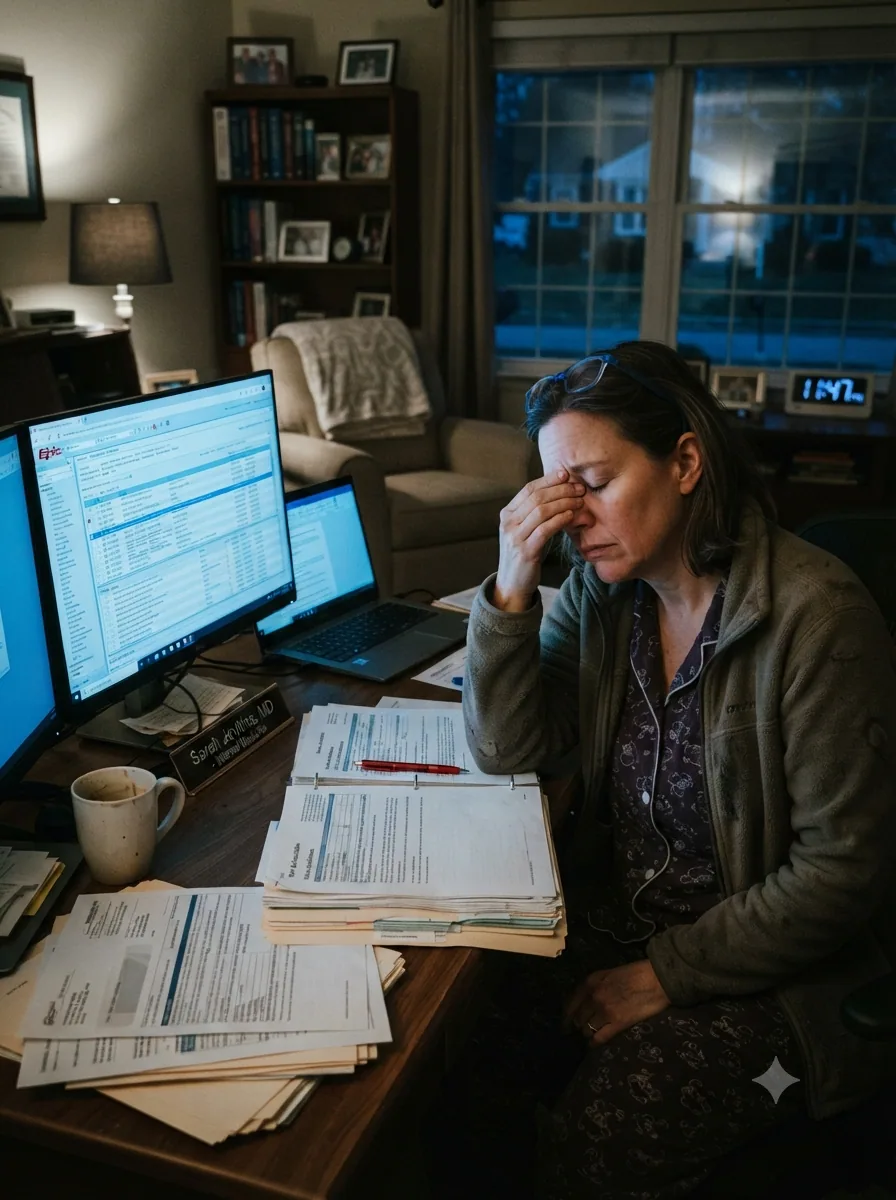
Driving home in her sedan, the silence of the car offered no comfort. She knew what was waiting for her on the dining room table. Her laptop. A steaming mug of tea that would grow cold while she worked. Her husband would be watching the evening news or reading a book, casting sympathetic glances her way as she opened the glowing screen to face the second shift of her workday.
For the next two to three hours every single night, Sarah sat in her living room bathed in the blue light of her computer monitor. She waded through the electronic health record inbox, clicking through dozens of lab results, imaging reports, and patient messages. She fought with algorithmic insurance denials, drafted prior authorization appeals, and signed off on medication refills. This unpaid, invisible labor had become the baseline expectation for modern primary care physicians. You could not simply ignore the inbox, because a missed lab result or an unread message could lead to a catastrophic medical error or a devastating malpractice lawsuit. Yet there was no time allotted during the working day to process it all.
As Sarah stared at the screen past nine o'clock that night, a profound wave of exhaustion washed over her—not just physical tiredness, but a deep, aching spiritual depletion. For years, medical leadership and wellness seminars had told physicians like Sarah that they were suffering from burnout. They were told to practice mindfulness, download meditation apps, eat better, and practice better work-life balance.
But Sarah and her colleagues knew the truth. Calling this crisis burnout was a dangerous misdiagnosis. Burnout implied that the individual doctor had simply run out of gas, that they were somehow failing to cope with the normal pressures of the job. What Sarah was experiencing was not burnout. It was moral injury.
Moral injury occurs when a person is repeatedly forced by systemic constraints, administrative rules, and profit-driven metrics to violate their core professional ethics and clinical judgment. Sarah had not spent eleven years in medical school and residency to rush elderly, vulnerable patients out of an examination room in seven minutes. She had not trained to be a data entry clerk whose primary allegiance was to corporate operating margins and shareholder returns. Every day she went to work, she was forced to participate in a system that delivered suboptimal care to the very people who trusted her with their lives. That realization was corrosive. It ate away at her sense of professional identity and personal integrity.
The consequences of this corporate erosion of primary care were visible everywhere, rippling outward to devastate communities. Across the country, primary care deserts were expanding as experienced physicians threw up their hands and walked away from traditional employment models. Rural and suburban clinics struggled to recruit new doctors, leaving patients facing four-month waitlists just to get a routine annual physical exam. When a patient developed a sudden, acute issue like a severe sinus infection, a sprained wrist, or a worsening cough, they found it impossible to get an appointment with their primary care physician.
As a result, patients were flooding emergency rooms and urgent care centers for routine, chronic care management. Hospitals celebrated the high volume of emergency room visits because it drove short-term revenue, but it was a catastrophic failure of healthcare delivery. An urgent care doctor who had never met the patient before would write a quick prescription for an antibiotic or a steroid, completely unaware of the patient's complex medication history or underlying kidney disease. The continuity of care was shattered, replaced by a fragmented, transactional system where nobody knew the patient as a whole person.
Yet, amid this bleak landscape of corporate consolidation and declining morale, a quiet revolution was beginning to take root across the medical profession. Frustrated by the constraints of traditional insurance-based networks, a growing vanguard of primary care physicians was voting with their feet. They were walking away from hospital systems and insurance conglomerates entirely to launch Direct Primary Care clinics.
Direct Primary Care, or DPC, offered a radical return to the roots of medicine. In a DPC model, physicians eliminated insurance companies from the equation altogether. Patients paid a modest, flat monthly subscription fee directly to the doctor, much like a gym membership or a streaming service. In exchange, they received unlimited access to their physician, same-day or next-day appointments that actually lasted forty-five to sixty minutes, transparent wholesale pricing for lab tests and generic medications, and direct communication with their doctor via phone, text, or video call.
When Sarah first heard about the Direct Primary Care model, she was skeptical. How could a medical practice survive without the sprawling billing departments and massive patient volume demanded by insurance companies? But as she read deeper and talked to colleagues who had made the leap, she realized the genius of the model. By cutting out the administrative bloat—the armies of billing specialists, compliance officers, and prior authorization clerks—overhead plummeted. A physician could manage a panel of six hundred to eight hundred patients instead of twenty-five hundred, spend as much time as needed with each person, and actually practice high-quality, preventative medicine.
The more Sarah thought about Direct Primary Care, the more she felt a flicker of the passion that had drawn her to medicine in the first place. She remembered why she had wanted to become a doctor: to listen, to care, to build trusting relationships over years and decades, helping families navigate the triumphs and tragedies of health and aging.
Back in her living room, the glowing screen of her laptop cast long shadows against the wall. The stack of electronic messages was still waiting. The prior authorizations still needed her signature. The corporate health system would wake up tomorrow morning expecting the same relentless assembly-line velocity, the same hurried patient encounters, the same soul-crushing administrative grind.
Sarah looked over at her husband, who was finally closing his book and turning off the lamp. Then she looked back at the computer screen. She closed the lid. The sharp click echoed quietly in the room.
She knew she could not sustain this life for another ten years. The clockwork clinic was breaking her spirit, and it was failing her patients. But as she sat there in the quiet dark, for the first time in months, the heavy knot in her chest felt slightly lighter. She realized she had a choice. She did not have to remain a cog in the corporate machine. The path forward was cl
Bài viết liên quan
The Eighty-Two Thousand Dollar Heart Attack: Surviving Medical Debt
Living on the Edge: How a Texas Barista Stretches Her Insulin to Stay Alive Between Jobs

Harvest of Glass: The Bitter Civil War Splitting Midwestern Farming Towns Over Solar Leases