Wall Street's Ledger: How Institutional Custody and Sovereign Balance Sheets Redefined Crypto Volatility
⚠️ Truyện hư cấu phục vụ giải trí. Nhân vật & tình tiết là sản phẩm tưởng tượng.
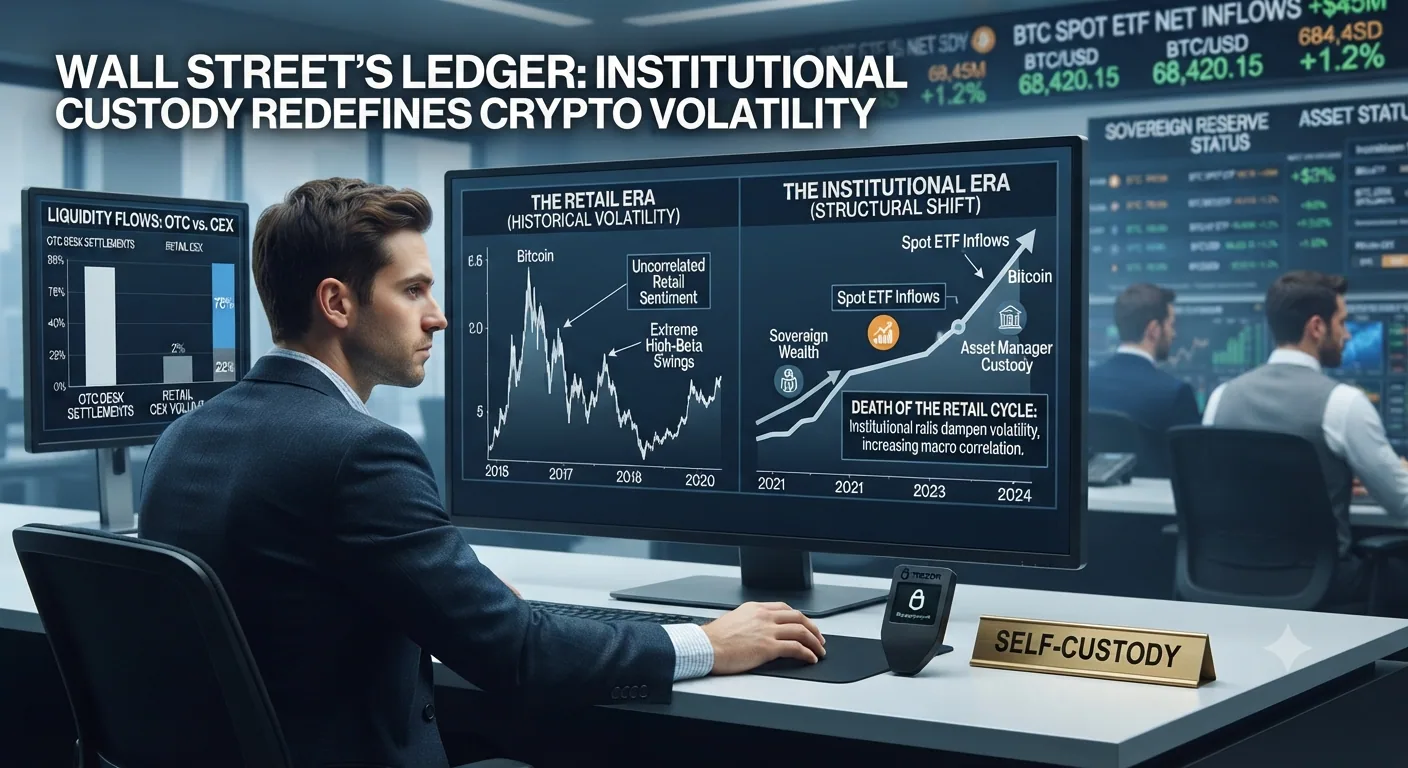
For over a decade, the narrative of digital assets was written by the chaotic, exuberant, and deeply unpredictable energy of retail participants. The historical rhythm of the market was defined by the four-year halving cycle, a predictable heartbeat fueled by retail FOMO, ideological fervor, residential mining operations, and speculative excess on centralized exchanges. During those years, price discovery was a wild, emotional rollercoaster. Fortunes were made and lost in overnight liquidations, driven by anonymous forums, viral social media sentiment, and the pure, unadulterated belief in a financial system built entirely outside the traditional corridors of power. But that era is now behind us, displaced by a profound structural transformation that has quietly and permanently altered the landscape of digital finance. We are living through the institutionalization of crypto, a massive paradigm shift marked by the dominance of spot exchange traded funds, institutional grade custody solutions, and the integration of digital assets into sovereign balance sheets.
To understand the magnitude of this shift, we must look closely at how liquidity flows have changed. In the early days, market depth was concentrated on retail facing centralized exchanges, where order books were thin, leverage was dangerously high, and sentiment could swing violently on a whim. Today, the plumbing of the market looks remarkably different. Trillions of dollars in institutional capital move quietly through over-the-counter desk settlements, regulated prime brokers, and structured financial vehicles that never touch a retail order book. When a major asset manager rebalances its portfolio or an endowment allocates a fraction of its holdings to digital assets, the transaction does not happen through a chaotic online marketplace. It is executed with institutional precision, dampening the historical volatility that once characterized the asset class and integrating digital tokens into the same sophisticated risk models used for traditional equities and commodities.
This evolution has fundamentally rewritten the rules of market volatility. Historically, Bitcoin and its digital peers were viewed as high beta speculative plays, prone to eighty percent drawdowns that frightened away traditional allocators. With the advent of spot exchange traded funds, access to the asset class has been democratized for institutional wealth, but it has also been institutionalized in terms of custody and control. Wall Street giants, global custody banks, and specialized digital asset custodians now hold the keys to the kingdom. This creates a powerful stabilizing force. Institutional holders tend to have longer investment horizons, sophisticated hedging strategies, and mandates that prevent panic selling during short term market corrections. As a result, the boom and bust cycles that once defined crypto are flattening out, replaced by a more mature, range bound, and macro correlated market structure.
Yet, this transition has not occurred without a deep cultural and philosophical tension. At the core of the original cypherpunk ethos was a radical commitment to self-custody and permissionless finance. The foundational idea was that individuals should be their own banks, holding their own private keys and interacting with decentralized protocols without needing the permission of any intermediary, regulator, or corporation. The institutionalization of crypto challenges this vision at every turn. Today’s dominant crypto products are heavily regulated, centralized, and gated by strict know your customer and anti money laundering protocols. When a pension fund or a corporate treasury gains exposure to digital assets through an exchange traded fund, they do not own the underlying asset in a sovereign, self-sovereign manner. They own a claim on a share managed by a custodian who answers to global regulatory bodies. This creates a fascinating paradox where the technology designed to bypass traditional financial gatekeepers is now being absorbed and anchored directly by those exact same institutions.
This tension is further amplified by the ongoing debate surrounding macro correlations and the nature of digital assets. For years, advocates argued that Bitcoin would serve as an independent sovereign digital gold, a pristine inflation hedge completely decoupled from traditional fiat systems and equity markets. However, as institutional capital has poured in, Bitcoin’s behavior has increasingly mirrored that of a high beta proxy for the Nasdaq and other risk-on growth assets. During periods of macroeconomic tightening, when central banks raise interest rates and liquidity contracts, digital assets frequently trade down in tandem with tech stocks. Institutional allocators view crypto not necessarily as an ideological escape hatch from the global monetary order, but as another asset class within a diversified portfolio, subject to the same macroeconomic gravity, liquidity cycles, and yield considerations as traditional equities.
Regulatory capture represents another critical dimension of this institutional shift. As digital finance intersects with mainstream capital markets, governments and international standard-setting bodies have moved aggressively to bring the ecosystem under the regulatory umbrella. The implementation of strict compliance frameworks, such as the Financial Action Task Force travel rule, has fundamentally altered how protocols and custodians operate. Autonomous, censorship-resistant smart contracts and decentralized finance applications now find themselves constantly navigating the boundaries of regulatory compliance. Traditional banking rails are increasingly integrated with blockchain networks, meaning that moving value on-chain is no longer an anonymous, borderless exercise, but a heavily monitored activity tethered to real-world identities and legal jurisdictions. While this integration provides the legitimacy and legal certainty required for massive institutional participation, it simultaneously forces the ecosystem to compromise on its founding ideals of absolute privacy and permissionless access.
Looking ahead, the long-term implications of sovereign reserve accumulation cannot be overstated. We are moving past the point where digital assets are merely a speculative plaything for tech enthusiasts and hedge funds. Governments, central banks, and sovereign wealth funds are beginning to evaluate digital assets through the lens of strategic national reserves. As global debt levels rise and currency debasement remains a persistent risk, the conversation around holding hard digital assets at the sovereign level has shifted from fringe theory to serious economic policy discussion. This sovereign adoption cements crypto's place in the global financial architecture, ensuring that it can never be easily wished away or regulated out of existence. However, it also completes the full circle of institutionalization, where the tools originally created to subvert state control are ultimately harnessed by the state itself.
Ultimately, the death of the retail cycle does not mean the death of crypto. Instead, it marks the end of adolescence and the beginning of a complex, highly regulated adulthood. The wild west era of crypto is giving way to a mature financial market where liquidity is deep, infrastructure is institutional grade, and participation is dominated by professional allocators. While those who fell in love with the untamed, cypherpunk wilderness of the early days may mourn the loss of its chaotic charm, the reality is that institutionalization is the ultimate validation of the technology. It proves that the underlying ledger technology is too powerful, too efficient, and too resilient to remain on the fringes of the global economy. As Wall Street and sovereign balance sheets permanently anchor themselves to the blockchain, digital assets have officially transitioned from a speculative counter-culture movement into the permanent bedrock of twenty-first-century global finance.
Bài viết liên quan

Silicon on the Blockchain: How DePIN and Crypto Compute Markets Are Challenging Big Tech’s AI Monopoly
Tokenizing the Real Economy: How Private Credit and Treasury Bills Found a Home On-Chain

Harvest of Glass: The Bitter Civil War Splitting Midwestern Farming Towns Over Solar Leases