Electric Vehicles vs Gas Cars Real Long Term Cost of Ownership
⚠️ Truyện hư cấu phục vụ giải trí. Nhân vật & tình tiết là sản phẩm tưởng tượng.
When you look at the automotive market today, choosing your next vehicle comes down to a fundamental financial and lifestyle puzzle. For decades, the traditional gas-powered car has been our default choice. You roll up to a pump, fill the tank with gasoline, and drive away. It is a familiar routine that has shaped our infrastructure and our personal budgets for over a century. Yet, electric vehicles have steadily moved from an eccentric niche into the mainstream consciousness. Every major manufacturer now offers a battery-powered alternative, promising a cleaner, quieter, and potentially cheaper driving experience. But when people talk about the cost of owning a car, the sticker price at the dealership is only the opening chapter of a much longer financial story. To truly understand whether an electric car or a traditional gas car makes more sense for your wallet, you have to look past the initial purchase price and examine the total cost of ownership over several years of real world driving. That means factoring in everything from daily energy expenses and routine maintenance to insurance rates, repairs, and how much the vehicle will be worth when you finally decide to sell it. Let us dive deep into the real long term numbers and explore how these two technologies stack up against each other.
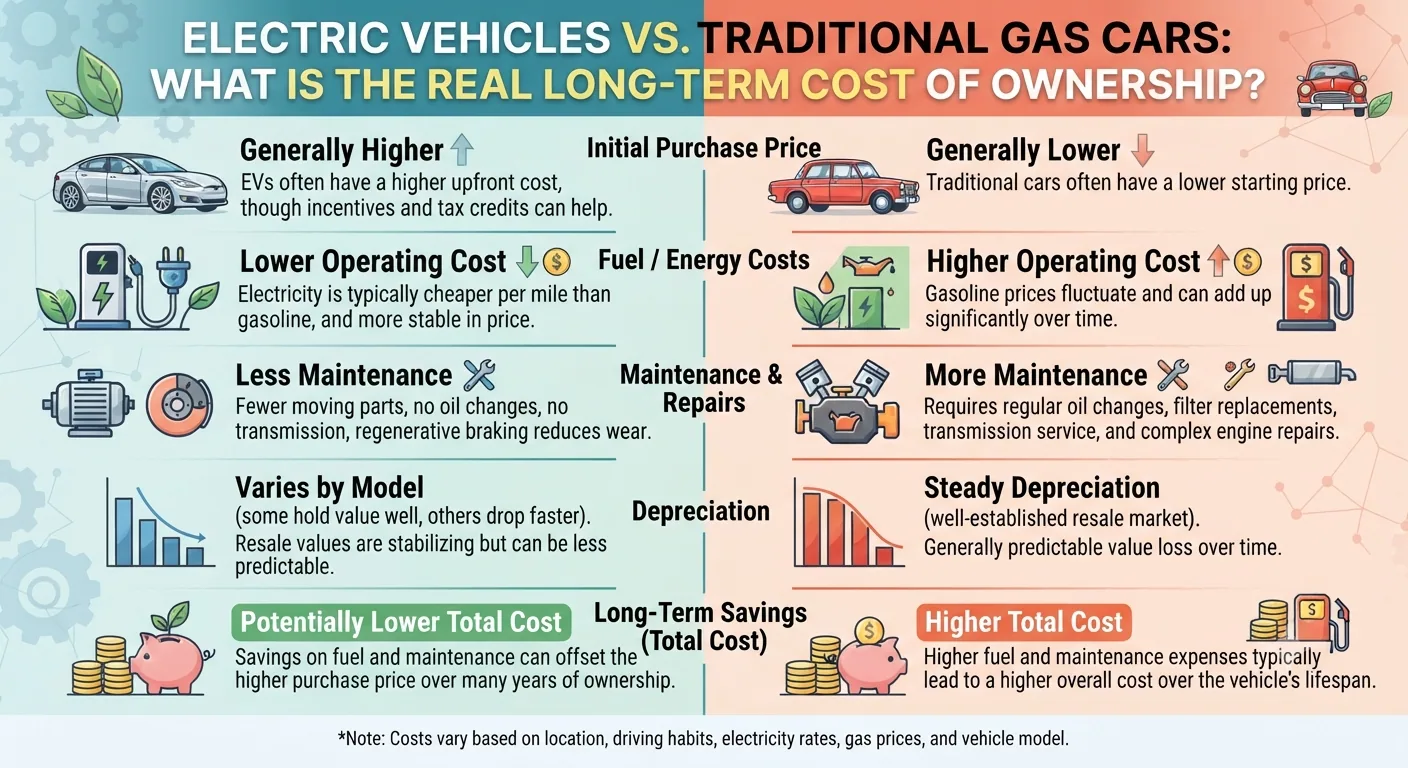
The comparison always starts at the dealership with the sticker price, and this is typically where traditional gas cars hold an immediate advantage. Even with government incentives and expanding manufacturing scales, the initial purchase price of a brand new electric vehicle often runs higher than its internal combustion engine counterpart. The primary culprit behind this price gap is the battery pack. Lithium ion batteries require expensive raw materials like lithium, cobalt, nickel, and manganese, and manufacturing them at scale is a complex and capital intensive process. When you compare a compact electric hatchback or an electric crossover to a similarly sized gas-powered model, you might notice a price difference of several thousand dollars. However, looking only at the MSRP can be misleading because it ignores government tax credits, rebates, and local incentives designed to bridge that exact gap. In many regions, federal, state, or provincial incentives can instantly slash thousands of dollars off the purchase price of a new electric vehicle, bringing it much closer to parity with a traditional gas car. Furthermore, the used car market for electric vehicles has grown substantially, offering second-hand buyers significant discounts on models that have already absorbed their initial depreciation hit. Even so, if you walk onto a dealership lot today and buy brand new without heavy incentives, a gas car will typically require less upfront capital investment than an electric equivalent.
Once you drive off the lot, the financial dynamics shift dramatically in favor of the electric vehicle, starting with the cost of energy. Fueling a traditional gas car is a recurring expense that fluctuates wildly based on geopolitical events, seasonal demand, and local taxes. Every week, millions of drivers pull up to gas stations to fill their tanks, watching the total dollar amount climb as refined petroleum flows into their vehicles. In contrast, electric vehicle owners plug their cars in at home, treating their vehicle much like a smartphone or a laptop. Charging an electric car overnight using residential electricity is almost universally cheaper than buying gasoline, assuming you have access to a home charger or a reliable garage. When you break down the cost per mile, a gas car typically burns through significantly more money per gallon of fuel than an electric car consumes in kilowatt hours of electricity. Even when factoring in the efficiency losses of charging and varying local electricity rates, the annual fuel savings for an average driver covering twelve to fifteen thousand miles a year can easily reach hundreds or even over a thousand dollars. Of course, this advantage depends heavily on where you live and how you charge. Drivers who rely entirely on public fast-charging networks while on the road will pay a premium that narrows the gap, because commercial fast chargers incur higher electricity rates and convenience fees. But for the vast majority of owners who do eighty percent or more of their charging at home during off peak hours, the electric vehicle represents a massive and consistent reduction in daily operating costs over time.
Beyond the energy required to move the vehicle down the road, maintenance and repair expenses play a massive role in the long term cost equation. Here, the internal combustion engine vehicle is weighed down by its sheer mechanical complexity. A traditional gas car contains thousands of moving parts operating under intense heat and friction. It requires regular engine oil changes, transmission fluid flushes, spark plug replacements, timing belt changes, coolant flushes, and exhaust system repairs. Over five to ten years of ownership, these routine services accumulate into a substantial maintenance bill, punctuated by the occasional major failure of a transmission, alternator, or fuel pump. An electric vehicle, on the other hand, operates with astonishing mechanical simplicity. An electric motor has a fraction of the moving parts found in a gas engine. There are no pistons, no valves, no spark plugs, and no engine oil to change. This means that a large chunk of traditional car maintenance simply disappears the moment you switch to electric. You will never pay for an oil change or a tune up again. Furthermore, electric vehicles utilize regenerative braking, a system that uses the electric motor to slow the vehicle down while recapturing energy to recharge the battery. This process drastically reduces wear and tear on traditional friction brake components, meaning brake pads and rotors on an electric vehicle often last two to three times longer than those on a gas car. When you look at scheduled maintenance over a five year period, electric vehicles consistently cost significantly less to keep on the road than gas cars.
However, the maintenance narrative is not entirely one sided, because you must also account for wear and tear items that behave differently in electric vehicles, most notably tires. Electric vehicles are inherently heavier than their gas counterparts due to the massive weight of the high voltage battery pack sitting in the floorpan. That extra weight, combined with the instant torque delivered by electric motors, puts a higher burden on the rubber meeting the road. As a result, electric vehicle owners often find themselves replacing tires sooner than drivers of lighter gas cars. Specialized low rolling resistance tires designed for electric vehicles can also carry a higher price tag. While tire expenses are higher, they rarely erase the substantial savings achieved through the elimination of engine service. The bigger question mark in the long term maintenance and repair discussion centers around the high voltage battery. While electric vehicle batteries are engineered to last the lifetime of the vehicle—often retaining healthy capacities past two hundred thousand miles—the fear of a catastrophic battery failure out of warranty looms large in the minds of consumers. If a battery does fail completely outside of its warranty window, replacing it can cost thousands of dollars. In contrast, while a gas car engine can also suffer catastrophic failure, the secondary and tertiary repair ecosystem for gas cars is mature, ubiquitous, and deeply integrated into thousands of independent mechanic shops across the country, whereas specialized electric vehicle technicians and diagnostic tools can sometimes carry dealership-level pricing.
Insurance costs represent another critical component of total cost of ownership where traditional gas cars currently hold the upper hand. If you call your insurance provider to quote a policy for a new electric vehicle, you will likely notice that the premium is higher than it would be for an equivalent gas-powered vehicle. There are several reasons for this disparity. First, the initial purchase price and replacement value of an electric vehicle are generally higher, meaning the insurance company faces a higher payout risk in the event of a total loss. Second, electric vehicles are packed with advanced electronics, sensors, and structural battery packs that require specialized collision repair facilities and certified technicians. Even a minor fender bender can result in expensive component replacements or mandatory battery diagnostic checks that inflate repair bills. Insurance companies factor these higher repair complexities directly into their underwriting models, resulting in premiums that can run fifteen to twenty five percent higher for electric vehicles compared to traditional cars. While some insurance providers offer eco-friendly discounts or are slowly adjusting their rates as repair networks mature, insurance remains an ongoing expense category where electric vehicle owners currently pay a monthly penalty that offsets a portion of their fuel and maintenance savings.
Depreciation is perhaps the most volatile and misunderstood variable in the total cost of ownership equation. When you buy a new car of any kind, it loses a substantial portion of its value the second you drive it off the lot. Historically, traditional gas cars followed a fairly predictable depreciation curve, losing value steadily over their first five years before leveling off. Electric vehicles have experienced a more turbulent depreciation trajectory, driven by rapid technological advancements, shifting government incentives, and aggressive price cuts by major manufacturers like Tesla. When a car manufacturer drops the price of a brand new electric vehicle by several thousand dollars overnight, it instantly crushes the resale value of every single used model currently sitting on the market or in private driveways. Early generations of electric vehicles also suffered from consumer anxiety regarding battery degradation, which depressed used market demand. However, as battery technology proves its durability and the secondary market matures, electric vehicle depreciation rates are stabilizing. Even so, if you purchase an electric vehicle, you must be prepared for the possibility that its residual value might fluctuate more dramatically than a stable, mass market gas car. For buyers who keep their cars for a decade or drive them until they are no longer roadworthy, depreciation matters less because the vehicle has been wrung dry of its utility. But for motorists who like to trade in every three to five years, depreciation represents a major financial factor that can easily swing the total cost of ownership pendulum.
To see how all these pieces fit together, let us look at the big picture over a typical five year ownership cycle. Imagine two drivers. Driver A purchases a reliable midsize gas-powered sedan, while Driver B purchases a comparable electric vehicle, factoring in a federal tax credit. Over the course of five years, Driver A pays for regular oil changes, spark plug checks, transmission services, and thousands of dollars in gasoline at local service stations. Driver B charges predominantly at home overnight, paying a fraction of that energy cost, and visits the mechanic only for routine tire rotations and cabin air filter replacements. However, Driver B pays slightly higher monthly insurance premiums throughout those five years. When they both look at depreciation, Driver B experienced a slightly steeper drop in vehicle value during the first three years, but Driver A spent significantly more cash out of pocket on routine operational upkeep and fueling. When you add up the purchase price, fuel, maintenance, insurance, and residual value, the total cost of ownership for both vehicles often converges much closer than people expect.